Odyssey of the Mind Structure Challenge
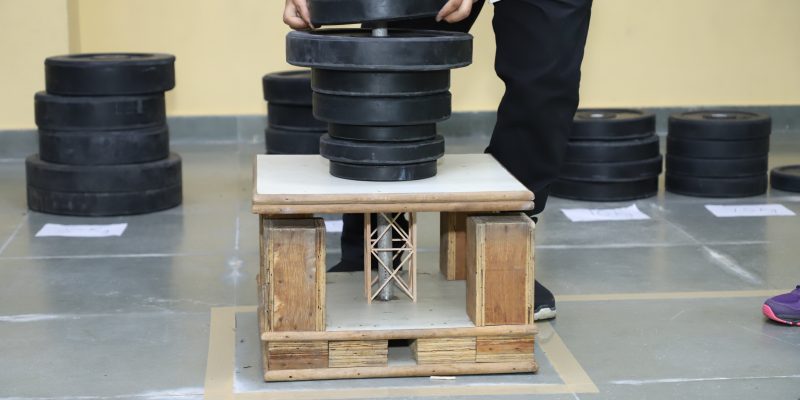
In this challenge students design and build the strongest possible structure using balsa wood, with a maximum weight of 18 grams and a minimum height of 8 inches. The goal is to create an original structure that can support and balance a stack of weights while getting hit, twisted, even broken apart or meeting the requirements of the annual problem. During the competition, the structure is tested to determine how much weight it can hold before breaking. Teams must carefully consider design, balance, stability, and weight distribution to maximise their structure’s strength while staying within the specified limits.
Imagine a structure made from just 18 grams of balsa wood holding an astonishing 690 kg of weight! This world record, achieved by a Division 1 team, showcases the incredible engineering potential of young students through innovative design and creative problem-solving.
Teams present a creative performance in which storytelling, acting and artistic expression bring their ideas to life. Within the 8-minute performance, the structure’s weight-holding test takes place as an integral part of the performance, allowing teams to showcase their engineering skills and creativity simultaneously.
Skill Students Developed by Structure Challenge
Engineering: Understanding structural strength, balance, stability and weight distribution.
Analytical & Cognitive Abilities: Team Analysing design problems and finding effective solutions to improve the structure’s weight holding capacity.
Iterative Design & Optimization: Testing different designs, identifying weaknesses and refining the structure to increase its weight-bearing capacity.
Teamwork: Team sharing responsibilities, exchanging ideas and working together to achieve a common goal.
Artistic Expression: Combining storytelling, acting and creative presentation with the structure’s weight-holding test.
Resourcefulness and Cost Management: Creating props, backdrops and styling elements using reused or discarded materials to manage costs effectively while encouraging resourcefulness and sustainable design practices.
Time Management: Coordinating the creative skit with the structure’s weight-holding test to complete all required elements within the 8-minute performance limit. A penalty of 1 point is deducted for every 2 seconds or fraction thereof, over the time limit, where overtime penalties apply under the problem rules.
2026-27 Structure Challenge
Copycat Structure
Are you copying me? In this problem, teams will use balsa wood and glue to make a structure which will be tested by balancing and holding as much weight as possible. They will also create a copycat structure that looks like the balsa wood and glue structure. During the performance, the copycat structure will mirror the actions and experiences of the balsa wood structure.